Introduction
You may hear terms like domain name, web hosting, WordPress, themes, plugins and SEO and wonder where you are supposed to begin.
The good news is that you don’t need to understand everything before you start.
You can build a WordPress website by following a few basic steps and learning as you go.
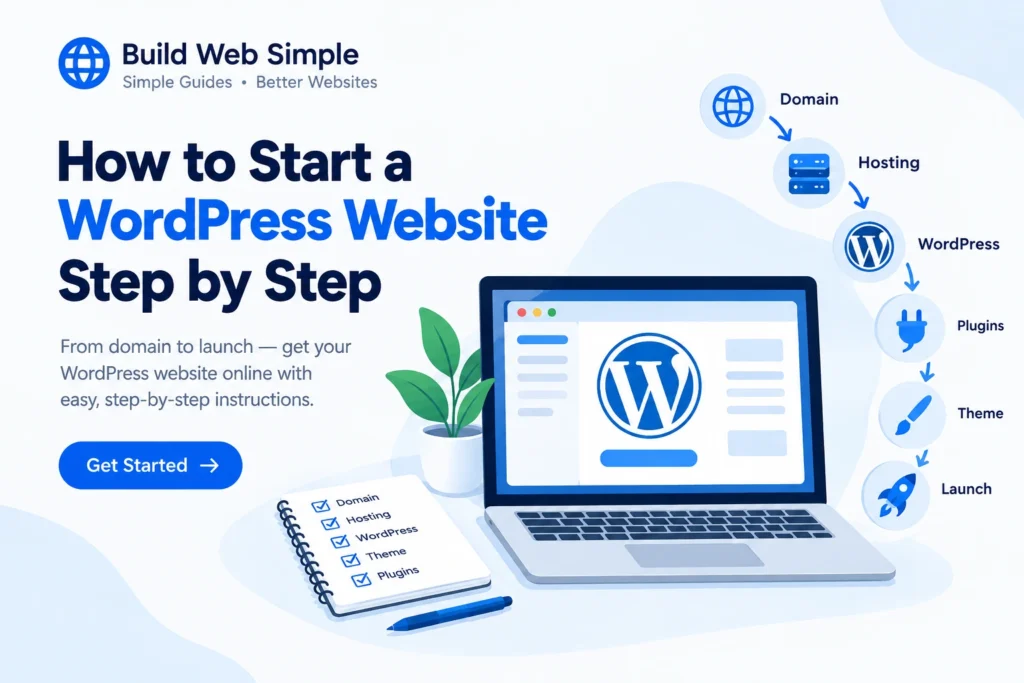
In this guide, we’ll walk through the process of starting a WordPress website from the beginning. You’ll learn how to choose a domain name, select web hosting, install WordPress, choose a theme, install essential plugins and prepare your website for visitors.
By the end, you’ll have a clear roadmap for getting your first WordPress website online.
What You Need to Start a WordPress Website
Before you begin, you only need a few basic things:
- A domain name — the address people use to visit your website.
- Web hosting — the service that stores your website and makes it available online.
- WordPress — the software you’ll use to build and manage your website.
- A WordPress theme — controls much of your website’s appearance.
- Plugins — add additional features to your website.
You don’t need to buy every tool you see recommended online. Start with the basics and add things when you actually need them.
Step 1: Choose a Domain Name
Your domain name is your website’s address.
For example:
example.com
A good domain name should be:
- Easy to remember
- Easy to spell
- Relatively short
- Relevant to your website
- Easy to say and type
Try to choose a name that gives visitors some idea of what your website is about.
Before registering a domain, check that the name is available and that you aren’t accidentally choosing a name that is too similar to an existing brand.
Don’t spend too much time looking for the perfect name
Your domain is important, but your content and the value you provide are even more important.
Choose a sensible name, register it and move forward.
Step 2: Choose Web Hosting
Once you have a domain name in mind, you’ll need web hosting.
Web hosting is where the files and database that make up your website are stored.
When someone visits your domain, the hosting server delivers your website to their browser.
There are several types of hosting, including:
- Shared hosting
- Managed WordPress hosting
- VPS hosting
- Cloud hosting
For a beginner website, shared hosting or managed WordPress hosting is often enough to get started.
When comparing hosting plans, look beyond the introductory price.
Consider:
- Performance
- Storage
- Backups
- Security features
- SSL support
- WordPress compatibility
- Customer support
- Renewal pricing
A cheap hosting plan isn’t necessarily the best choice if it provides poor performance or support.
If you’re not sure which hosting plan is right for your website, read our guide on
how to choose the best web hosting for WordPress.
Step 3: Connect Your Domain and Hosting
If you purchase your domain and hosting from different companies, you’ll need to connect them.
This is usually done by changing the domain’s nameservers or DNS settings to point to your hosting provider.
If you purchase both from the same provider, the connection may happen automatically.
Don’t worry if DNS sounds complicated. Your hosting provider normally provides instructions for completing this step.
After changing DNS settings, it can take some time before the changes are visible everywhere.
Step 4: Install WordPress
Now it’s time to install WordPress.
Many hosting companies provide an automatic WordPress installation option.
The exact process varies between hosting providers, but it usually involves:
- Logging into your hosting account.
- Finding the WordPress installation tool.
- Selecting your domain.
- Creating your WordPress administrator account.
- Choosing a username and strong password.
- Starting the installation.
Once installation is complete, you can log into your WordPress dashboard.
Your dashboard will normally be available at:
yourdomain.com/wp-admin
Keep your administrator login details secure and never share your password with anyone.
Step 5: Configure the Basic WordPress Settings
Before designing your website, take a few minutes to check the basic settings.
In your WordPress dashboard, go to:
Settings → General
Check your:
- Site title
- Tagline
- WordPress address
- Site address
- Administration email
- Site language
- Time zone
Don’t change settings unless you understand what they do.
Step 6: Set Your Permalink Structure
Permalinks determine how the URLs of your posts and pages are structured.
Go to:
Settings → Permalinks
For most beginner websites, Post name is a simple and clean option.
For example:
yourdomain.com/how-to-start-a-wordpress-website/
A clear URL is easier for people to understand and easier to manage.
It’s best to choose your permalink structure early rather than changing it repeatedly after publishing many articles.
Step 7: Choose a WordPress Theme
Your theme controls much of the visual appearance of your website.
You can choose from thousands of free and premium WordPress themes.
When choosing a theme, look for:
- Responsive design
- Good performance
- Regular updates
- Compatibility with your WordPress version
- Good customization options
- Clean design
- Good documentation or support
Don’t choose a theme simply because it has hundreds of features.
A lightweight theme with the features you actually need can be a better choice than a theme overloaded with unnecessary options.
Before choosing a theme, learn what features you should look for in our guide on
how to choose a WordPress theme.
Step 8: Customize Your Website
After installing your theme, customize the basic appearance of your website.
Depending on your theme, you may be able to change:
- Logo
- Colors
- Fonts
- Header
- Navigation menu
- Footer
- Homepage
- Buttons
- Layouts
Try to keep your design simple.
A professional website doesn’t need dozens of colors, animations and complicated layouts.
Focus on making your website:
Clear → Easy to navigate → Easy to read → Mobile-friendly
Step 9: Create the Important Pages
Before publishing lots of blog posts, create the basic pages your visitors may need.
Common pages include:
- Home
- About
- Contact
- Privacy Policy
- Terms & Conditions
If you use affiliate links, you should also provide an appropriate affiliate disclosure.
Your website may need additional pages depending on what you do and where your visitors are located
Step 10: Install Essential Plugins
Plugins allow you to add features to WordPress without writing all the code yourself.
For example, plugins can provide:
- SEO features
- Contact forms
- Security features
- Caching
- Backups
- Analytics
- WooCommerce functionality
However, don’t install plugins just because someone says they’re “essential.”
Every plugin adds another piece of software to your website.
Before installing one, consider:
- Do I actually need it?
- Is it actively maintained?
- Does it have good reviews?
- Is it compatible with my WordPress version?
- Could another plugin already provide the same feature?
Quality is more important than quantity. What is a WordPress plugin
Step 11: Create Your Navigation Menu
Your navigation menu helps visitors find the important parts of your website.
Keep the main menu simple.
Depending on your website, you might include:
Home | Start Here | WordPress | Hosting | Themes | Plugins | WooCommerce | Blogging & SEO
You don’t need to put every page in the main navigation.
The goal is to help visitors find your most important content quickly.
Step 12: Create Your First Blog Post
Now you can start creating content.
Your first article doesn’t need to be perfect.
Instead, focus on answering a real question that your target audience is searching for.
A useful blog post should:
- Solve a specific problem
- Be easy to read
- Have clear headings
- Provide practical information
- Avoid unnecessary filler
- Link to related content when appropriate
As you publish more useful articles, you can build a library of content around your main topics.
Step 13: Learn the Basics of SEO
SEO stands for Search Engine Optimization.
It involves improving your website and content so that search engines can better understand your pages and users can discover them through search.
Some basic SEO practices include:
- Choose a clear topic for each article.
- Use descriptive page titles.
- Create useful headings.
- Write helpful original content.
- Use descriptive URLs.
- Add relevant internal links.
- Optimize images.
- Make your website mobile-friendly.
- Keep your website reasonably fast.
Don’t try to manipulate search engines with keyword stuffing or other shortcuts.
Your first priority should be creating genuinely useful content for people.
Step 14: Make Your Website Mobile-Friendly
A large portion of website traffic can come from mobile devices.
After building your website, check how it looks on:
- Desktop
- Tablet
- Mobile
Pay attention to:
- Text size
- Buttons
- Navigation
- Images
- Spacing
- Forms
- Page loading speed
A page that looks great on a large monitor can still have problems on a phone.
Step 15: Secure and Maintain Your Website
Launching your website isn’t the end.
You also need to maintain it.
Regularly:
- Update WordPress
- Update themes
- Update plugins
- Keep backups
- Use strong passwords
- Remove unused plugins and themes
- Check your website for problems
Before major updates, having a recent backup can give you an easier way to recover if something goes wrong.
ommon Mistakes Beginners Should Avoid
Starting a website is exciting, but it’s easy to make unnecessary mistakes.
Installing too many plugins
More plugins don’t automatically make a better website.
Install what you need and remove plugins you no longer use.
Changing your theme constantly
It’s tempting to keep searching for a better-looking theme.
Choose a good theme and spend your time improving your content instead.
Trying to publish everything at once
You don’t need 100 articles on your first day.
Start with useful content and build your website gradually.
Ignoring mobile users
Always check your website on a phone before considering a page finished.
Focusing only on design
A beautiful website with poor content won’t provide much value.
Design matters, but useful content matters more.
Chasing quick SEO results
SEO usually takes time.
Instead of looking for shortcuts, focus on creating useful content and building a well-organized website.
WordPress Website Launch Checklist
Before announcing your website to the world, go through this checklist:
- Domain is connected
- WordPress is installed
- Site title and settings are correct
- Permalinks are configured
- Theme is installed and customized
- Navigation menu is working
- Important pages are published
- Essential plugins are configured
- Contact form works
- Website works on mobile
- Website has an SSL certificate
- First articles are published
- Basic SEO is configured
- Website has a backup system
You don’t have to wait until everything is perfect.
Once the important pieces are working, you can launch and continue improving your website.
Frequently Asked Questions
Is WordPress free?
The WordPress software itself is free and open source. However, you’ll normally need to pay for services such as web hosting and a domain name.
How much does it cost to start a WordPress website?
The cost depends on your domain, hosting and any premium products you choose. You can start relatively cheaply with a basic domain and hosting plan, then invest more as your website grows.
Do I need coding skills to use WordPress?
No. You can create and manage many types of WordPress websites without knowing how to code. Basic HTML, CSS or PHP knowledge can become useful later, but it isn’t required to get started.
Can I start WordPress without buying hosting?
If you’re using self-hosted WordPress, you’ll need web hosting. WordPress.com is a different service with its own hosting, plans and features.
How long does it take to build a WordPress website?
A basic website can be created relatively quickly, but the amount of time depends on its complexity, design and content. Building a useful website is an ongoing process rather than a one-time task.
How many plugins should I install?
There is no fixed number that is right for every website. Install only the plugins you actually need and choose reputable, maintained plugins.
Conclusion
Starting a WordPress website doesn’t have to be overwhelming.
You can break the process into simple steps: choose a domain, get hosting, install WordPress, choose a theme, create your important pages, add the features you need and start publishing useful content.
You don’t need to know everything before you begin.
Start with the basics, learn as you go and improve your website one step at a time.
If you’re just getting started, visit our Start Here guide for a simple roadmap to building your website.